
(BlogPost: { "ab" : false, "abStatus" : null, "abTestId" : null, "abVariation" : false, "abVariationAutomated" : false, "absoluteUrl" : "https://www.cyclonesante.com/en/blogue/lergonomie-au-travail-investir-dans-la-santé-pour-propulser-la-performance-organisationnelle", "afterPostBody" : null, "aifeatures" : null, "allowedSlugConflict" : false, "analytics" : null, "analyticsPageId" : "210224214353", "analyticsPageType" : "blog-post", "approvalStatus" : null, "archived" : false, "archivedAt" : 0, "archivedInDashboard" : false, "areCommentsAllowed" : true, "attachedStylesheets" : [ ], "audienceAccess" : "PUBLIC", "author" : null, "authorName" : null, "authorUsername" : null, "blogAuthor" : { "avatar" : "", "bio" : "", "cdnPurgeEmbargoTime" : null, "cosObjectType" : "BLOG_AUTHOR", "created" : 1728585187672, "deletedAt" : 0, "displayName" : "Admin", "email" : null, "facebook" : "", "fullName" : "Admin", "gravatarUrl" : null, "hasSocialProfiles" : false, "id" : 180707806338, "label" : "Admin", "language" : null, "linkedin" : "", "name" : "Admin", "portalId" : 47608944, "slug" : "admin", "translatedFromId" : null, "translations" : { }, "twitter" : "", "twitterUsername" : "", "updated" : 1728585187672, "userId" : null, "username" : null, "website" : "" }, "blogAuthorId" : 180707806338, "blogAuthorIdList" : [ 180707806338 ], "blogAuthorList" : [ { "avatar" : "", "bio" : "", "cdnPurgeEmbargoTime" : null, "cosObjectType" : "BLOG_AUTHOR", "created" : 1728585187672, "deletedAt" : 0, "displayName" : "Admin", "email" : null, "facebook" : "", "fullName" : "Admin", "gravatarUrl" : null, "hasSocialProfiles" : false, "id" : 180707806338, "label" : "Admin", "language" : null, "linkedin" : "", "name" : "Admin", "portalId" : 47608944, "slug" : "admin", "translatedFromId" : null, "translations" : { }, "twitter" : "", "twitterUsername" : "", "updated" : 1728585187672, "userId" : null, "username" : null, "website" : "" } ], "blogPostAuthor" : { "avatar" : "", "bio" : "", "cdnPurgeEmbargoTime" : null, "cosObjectType" : "BLOG_AUTHOR", "created" : 1728585187672, "deletedAt" : 0, "displayName" : "Admin", "email" : null, "facebook" : "", "fullName" : "Admin", "gravatarUrl" : null, "hasSocialProfiles" : false, "id" : 180707806338, "label" : "Admin", "language" : null, "linkedin" : "", "name" : "Admin", "portalId" : 47608944, "slug" : "admin", "translatedFromId" : null, "translations" : { }, "twitter" : "", "twitterUsername" : "", "updated" : 1728585187672, "userId" : null, "username" : null, "website" : "" }, "blogPostScheduleTaskUid" : null, "blogPublishInstantEmailCampaignId" : null, "blogPublishInstantEmailRetryCount" : 0, "blogPublishInstantEmailTaskUid" : null, "blogPublishToSocialMediaTask" : "DONE_NOT_SENT", "blueprintTypeId" : 0, "businessUnitId" : null, "campaign" : null, "campaignName" : null, "campaignUtm" : null, "category" : 3, "categoryId" : 3, "cdnPurgeEmbargoTime" : null, "checkPostLevelAudienceAccessFirst" : true, "clonedFrom" : 210224127145, "composeBody" : null, "compositionId" : 0, "contentAccessRuleIds" : [ ], "contentAccessRuleTypes" : [ ], "contentGroup" : 210228806966, "contentGroupId" : 210228806966, "contentTypeCategory" : 3, "contentTypeCategoryId" : 3, "contentTypeId" : null, "created" : 1774914776908, "createdByAgent" : null, "createdById" : 88055306, "createdTime" : 1774914776908, "crmObjectId" : null, "css" : { }, "cssText" : "", "ctaClicks" : null, "ctaViews" : null, "currentState" : "PUBLISHED", "currentlyPublished" : true, "deletedAt" : 0, "deletedBy" : null, "deletedByEmail" : null, "deletedById" : null, "domain" : "", "dynamicPageDataSourceId" : null, "dynamicPageDataSourceType" : null, "dynamicPageHubDbTableId" : null, "editorVersion" : "1.0", "enableDomainStylesheets" : null, "enableGoogleAmpOutputOverride" : false, "enableLayoutStylesheets" : null, "errors" : [ ], "featuredImage" : "", "featuredImageAltText" : "", "featuredImageHeight" : 0, "featuredImageLength" : 0, "featuredImageWidth" : 0, "flexAreas" : { }, "folderId" : null, "footerHtml" : null, "footerTemplatePath" : null, "footerVariantName" : null, "freezeDate" : 1774914823000, "generateJsonLdEnabledOverride" : true, "globalBlockOverrides" : { }, "hasContentAccessRules" : false, "hasUserChanges" : true, "headHtml" : null, "header" : null, "headerTemplatePath" : null, "headerVariantName" : null, "htmlTitle" : "Ergonomics at Work: Investing in Health to Drive Organizational Performance", "id" : 210224214353, "includeDefaultCustomCss" : null, "isCaptchaRequired" : false, "isCrawlableByBots" : false, "isDraft" : false, "isInstantEmailEnabled" : false, "isPublished" : true, "isSocialPublishingEnabled" : false, "keywords" : [ ], "label" : "<span id=\"hs_cos_wrapper_name\" class=\"hs_cos_wrapper hs_cos_wrapper_meta_field hs_cos_wrapper_type_text\" style=\"\" data-hs-cos-general-type=\"meta_field\" data-hs-cos-type=\"text\" >Ergonomics at Work: Investing in Health to Drive Organizational Performance</span>", "language" : "en", "lastEditSessionId" : null, "lastEditUpdateId" : null, "layoutSections" : { }, "legacyBlogTabid" : null, "legacyId" : null, "legacyPostGuid" : "", "linkRelCanonicalUrl" : "", "listTemplate" : "", "liveDomain" : "www.cyclonesante.com", "mab" : false, "mabExperimentId" : null, "mabMaster" : false, "mabVariant" : false, "marketingCampaignGuids" : [ ], "meta" : { "publish_immediately" : true, "html_title" : "Ergonomics at Work: Investing in Health to Drive Organizational Performance", "meta_description" : "Petite visite de nos nouveaux locaux à Montréal\n", "post_body" : "<span id=\"hs_cos_wrapper_post_body\" class=\"hs_cos_wrapper hs_cos_wrapper_meta_field hs_cos_wrapper_type_rich_text\" style=\"\" data-hs-cos-general-type=\"meta_field\" data-hs-cos-type=\"rich_text\" ><p><span>In a professional world undergoing constant transformation where hybrid work and the digitalization of tasks have become the norm, the physical health of teams faces an unprecedented challenge. Too often, ergonomics is relegated to the status of mere \"office comfort\" or an aesthetic choice for furniture. Yet, ergonomics plays a pivotal role in preventing workplace injuries.</span></p>\n<!--more--><p><span>In Quebec, data from the National Institute of Public Health (INSPQ) sounds the alarm: nearly 25% of workers suffer from musculoskeletal disorders (MSDs) related to their job functions. These injuries, which affect muscles, tendons, and nerves, are not just painful for the individual; they represent a significant financial burden for organizations due to absenteeism and lost productivity.</span></p>\n<h2>&nbsp;</h2>\n<h2><strong><span>The Invisible Enemy: Why Does the Office Hurt Us?</span></strong></h2>\n<p><span>The human body is an engineering marvel designed for action, walking, and movement. However, modern office work imposes a prolonged static load. When we remain motionless in front of a screen, our blood circulation slows down, oxygen supply to the muscles decreases, and metabolic toxins accumulate.</span></p>\n<p><span>Even more serious is the constant pressure on intervertebral discs without the decompression phases normally provided by walking. Over the long term, this stagnation can cause premature tissue wear. The mission of ergonomics is to adapt the work environment to human physiological limits, not the other other way around.</span></p>\n<hr>\n<h2><strong><span>1. The First Pillar: The Dynamics of Movement</span></strong></h2>\n<p><span>Perhaps the most important principle in modern ergonomics is this: \"Your best posture is your next posture.\" No position, no matter how technically perfect, should be maintained for hours on end.</span></p>\n<ul>\n<li><span>The Power of Micro-breaks: Research in cognitive and physical ergonomics shows that concentration levels drop and muscle fatigue sets in after only 30 to 45 minutes of static work.</span></li>\n<li><span>The Essential Habit: Stand up or stretch every 30 to 60 minutes. This is not a waste of time; it is a biological reset.</span></li>\n<li><span>Variety: If you use a sit-stand desk, the goal is not to stand for eight hours (which fatigues the lower limbs), but to alternate positions approximately every two hours.</span></li>\n</ul>\n<p><span>By breaking sedentary patterns, you restart the \"blood pump\" and reduce soft tissue inflammation. It is your first line of defense against chronic pain.</span></p>\n<h2>&nbsp;</h2>\n<h2><strong><span>2. The Second Pillar: Postural Alignment and the 90° Rule</span></strong></h2>\n<p><span>Poor sitting posture is often the starting point for chronic lower back pain. A chair should not be just a seat, but an active support tool.</span></p>\n<p><span>The Geometry of Comfort: To minimize tension, it is crucial to respect the natural alignment of your joints:</span></p>\n<ul>\n<li><span>The Right Angle (90°): Elbows should rest close to the body, forming a right angle toward the keyboard. Knees and hips should also follow this rule.</span></li>\n<li><span>Foot Support: If your feet do not touch the floor firmly, the weight of your legs pulls on your lumbar vertebrae. Using a footrest can, on its own, resolve many back issues.</span></li>\n<li><span>Lumbar Support: The natural curve of the lower back must be supported by the chair's backrest. Without this support, the spine collapses into a \"C\" shape, creating uneven pressure on the discs.</span></li>\n</ul>\n<h2><strong><span><img src=\"https://47608944.fs1.hubspotusercontent-na1.net/hubfs/47608944/undefined.png\" width=\"1600\" height=\"895\" loading=\"lazy\" alt=\"undefined\" style=\"height: auto; max-width: 100%; width: 1600px;\"></span></strong></h2>\n<h2>&nbsp;</h2>\n<h2><strong><span>3. The Third Pillar: The Cervical Zone and the Visual Horizon</span></strong></h2>\n<p><span>\"Tech neck\" is no longer reserved for smartphone users; it threatens any worker whose screen is poorly positioned. When you tilt your head forward by just 15 degrees, the actual weight supported by your neck doubles, jumping from about 12 lbs to nearly 27 lbs.</span></p>\n<p><span>Protecting Your Neck:</span></p>\n<ul>\n<li><span>Screen Height: The top of your monitor should be at eye level. This allows your gaze to descend naturally toward the center of the screen without your neck bending forward.</span></li>\n<li><span>Distance: The screen should be about an arm's length away. Too close, and you strain your eyes; too far, and you unconsciously jut your chin forward to read better, creating tension at the base of the skull.</span></li>\n</ul>\n<h2>&nbsp;</h2>\n<h2><strong><span>The Financial Impact: Why HR Must Care</span></strong></h2>\n<p><span>Investing in ergonomics is a logical business decision. The cost of a high-quality ergonomic chair and a monitor stand is minimal compared to the costs of a prolonged absence.</span></p>\n<ul>\n<li><span>The Cost of \"Presenteeism\": Beyond absenteeism (the employee who doesn't show up), there is </span><em><span>presenteeism</span></em><span>. This occurs when an employee is at their desk but their productivity is reduced by 20% to 50% because they are struggling with a dull ache or a tension migraine. An ergonomic environment maintains high levels of focus and engagement throughout the day.</span></li>\n<li><span>Retention and Employer Branding: In a labor market where talent is scarce, attention to physical health is a powerful signal. A company that provides adapted equipment and encourages active breaks demonstrates an authentic culture of well-being, thereby promoting employee retention.</span></li>\n</ul>\n<h2>&nbsp;</h2>\n<h2><strong><span>Conclusion</span></strong></h2>\n<p><span>Ergonomics should no longer be seen as an option, but as a wise investment in prevention. By educating your teams on the importance of movement, proper screen adjustment, and posture, you are acting on your company’s most precious lever: human capital.</span></p></span>", "featured_image" : "", "use_featured_image" : false, "tag_ids" : [ ], "topic_ids" : [ ], "blog_publish_instant_email_task_uid" : null, "blog_publish_to_social_media_task" : "DONE_NOT_SENT", "include_default_custom_css" : false, "enable_domain_stylesheets" : false, "enable_layout_stylesheets" : false, "attached_stylesheets" : [ ], "featured_image_height" : 0, "featured_image_width" : 0, "post_summary" : "<p><span>In a professional world undergoing constant transformation where hybrid work and the digitalization of tasks have become the norm, the physical health of teams faces an unprecedented challenge. Too often, ergonomics is relegated to the status of mere \"office comfort\" or an aesthetic choice for furniture. Yet, ergonomics plays a pivotal role in preventing workplace injuries.</span></p>\n", "has_user_changes" : true, "password" : null, "last_edit_session_id" : null, "last_edit_update_id" : null, "published_by_id" : 88055306, "published_at" : 1774914828863, "rss_body" : "<p><span>In a professional world undergoing constant transformation where hybrid work and the digitalization of tasks have become the norm, the physical health of teams faces an unprecedented challenge. Too often, ergonomics is relegated to the status of mere \"office comfort\" or an aesthetic choice for furniture. Yet, ergonomics plays a pivotal role in preventing workplace injuries.</span></p>\n<!--more--><p><span>In Quebec, data from the National Institute of Public Health (INSPQ) sounds the alarm: nearly 25% of workers suffer from musculoskeletal disorders (MSDs) related to their job functions. These injuries, which affect muscles, tendons, and nerves, are not just painful for the individual; they represent a significant financial burden for organizations due to absenteeism and lost productivity.</span></p>\n<h2>&nbsp;</h2>\n<h2><strong><span>The Invisible Enemy: Why Does the Office Hurt Us?</span></strong></h2>\n<p><span>The human body is an engineering marvel designed for action, walking, and movement. However, modern office work imposes a prolonged static load. When we remain motionless in front of a screen, our blood circulation slows down, oxygen supply to the muscles decreases, and metabolic toxins accumulate.</span></p>\n<p><span>Even more serious is the constant pressure on intervertebral discs without the decompression phases normally provided by walking. Over the long term, this stagnation can cause premature tissue wear. The mission of ergonomics is to adapt the work environment to human physiological limits, not the other other way around.</span></p>\n<hr>\n<h2><strong><span>1. The First Pillar: The Dynamics of Movement</span></strong></h2>\n<p><span>Perhaps the most important principle in modern ergonomics is this: \"Your best posture is your next posture.\" No position, no matter how technically perfect, should be maintained for hours on end.</span></p>\n<ul>\n<li><span>The Power of Micro-breaks: Research in cognitive and physical ergonomics shows that concentration levels drop and muscle fatigue sets in after only 30 to 45 minutes of static work.</span></li>\n<li><span>The Essential Habit: Stand up or stretch every 30 to 60 minutes. This is not a waste of time; it is a biological reset.</span></li>\n<li><span>Variety: If you use a sit-stand desk, the goal is not to stand for eight hours (which fatigues the lower limbs), but to alternate positions approximately every two hours.</span></li>\n</ul>\n<p><span>By breaking sedentary patterns, you restart the \"blood pump\" and reduce soft tissue inflammation. It is your first line of defense against chronic pain.</span></p>\n<h2>&nbsp;</h2>\n<h2><strong><span>2. The Second Pillar: Postural Alignment and the 90° Rule</span></strong></h2>\n<p><span>Poor sitting posture is often the starting point for chronic lower back pain. A chair should not be just a seat, but an active support tool.</span></p>\n<p><span>The Geometry of Comfort: To minimize tension, it is crucial to respect the natural alignment of your joints:</span></p>\n<ul>\n<li><span>The Right Angle (90°): Elbows should rest close to the body, forming a right angle toward the keyboard. Knees and hips should also follow this rule.</span></li>\n<li><span>Foot Support: If your feet do not touch the floor firmly, the weight of your legs pulls on your lumbar vertebrae. Using a footrest can, on its own, resolve many back issues.</span></li>\n<li><span>Lumbar Support: The natural curve of the lower back must be supported by the chair's backrest. Without this support, the spine collapses into a \"C\" shape, creating uneven pressure on the discs.</span></li>\n</ul>\n<h2><strong><span><img src=\"https://47608944.fs1.hubspotusercontent-na1.net/hubfs/47608944/undefined.png\" width=\"1600\" height=\"895\" loading=\"lazy\" alt=\"undefined\" style=\"height: auto; max-width: 100%; width: 1600px;\"></span></strong></h2>\n<h2>&nbsp;</h2>\n<h2><strong><span>3. The Third Pillar: The Cervical Zone and the Visual Horizon</span></strong></h2>\n<p><span>\"Tech neck\" is no longer reserved for smartphone users; it threatens any worker whose screen is poorly positioned. When you tilt your head forward by just 15 degrees, the actual weight supported by your neck doubles, jumping from about 12 lbs to nearly 27 lbs.</span></p>\n<p><span>Protecting Your Neck:</span></p>\n<ul>\n<li><span>Screen Height: The top of your monitor should be at eye level. This allows your gaze to descend naturally toward the center of the screen without your neck bending forward.</span></li>\n<li><span>Distance: The screen should be about an arm's length away. Too close, and you strain your eyes; too far, and you unconsciously jut your chin forward to read better, creating tension at the base of the skull.</span></li>\n</ul>\n<h2>&nbsp;</h2>\n<h2><strong><span>The Financial Impact: Why HR Must Care</span></strong></h2>\n<p><span>Investing in ergonomics is a logical business decision. The cost of a high-quality ergonomic chair and a monitor stand is minimal compared to the costs of a prolonged absence.</span></p>\n<ul>\n<li><span>The Cost of \"Presenteeism\": Beyond absenteeism (the employee who doesn't show up), there is </span><em><span>presenteeism</span></em><span>. This occurs when an employee is at their desk but their productivity is reduced by 20% to 50% because they are struggling with a dull ache or a tension migraine. An ergonomic environment maintains high levels of focus and engagement throughout the day.</span></li>\n<li><span>Retention and Employer Branding: In a labor market where talent is scarce, attention to physical health is a powerful signal. A company that provides adapted equipment and encourages active breaks demonstrates an authentic culture of well-being, thereby promoting employee retention.</span></li>\n</ul>\n<h2>&nbsp;</h2>\n<h2><strong><span>Conclusion</span></strong></h2>\n<p><span>Ergonomics should no longer be seen as an option, but as a wise investment in prevention. By educating your teams on the importance of movement, proper screen adjustment, and posture, you are acting on your company’s most precious lever: human capital.</span></p>", "rss_summary" : "<p><span>In a professional world undergoing constant transformation where hybrid work and the digitalization of tasks have become the norm, the physical health of teams faces an unprecedented challenge. Too often, ergonomics is relegated to the status of mere \"office comfort\" or an aesthetic choice for furniture. Yet, ergonomics plays a pivotal role in preventing workplace injuries.</span></p>\n", "blog_post_schedule_task_uid" : null, "scheduled_update_date" : 0, "cloned_from" : 210224127145, "link_rel_canonical_url" : "", "is_staged_page" : false, "page_redirected" : false, "page_expiry_enabled" : false, "page_expiry_redirect_id" : null, "page_expiry_redirect_url" : null, "page_expiry_date" : null, "created_by_agent" : null, "composition_id" : 0, "legacy_post_guid" : "", "legacy_blog_tabid" : null, "blog_publish_instant_email_campaign_id" : null, "blog_publish_instant_email_retry_count" : 0, "campaign_name" : null, "campaign_utm" : null, "enable_google_amp_output_override" : false, "featured_image_alt_text" : "", "head_html" : null, "is_crawlable_by_bots" : false, "public_access_rules" : [ ], "public_access_rules_enabled" : false, "layout_sections" : { }, "header" : null }, "metaDescription" : "Petite visite de nos nouveaux locaux à Montréal\n", "metaKeywords" : null, "name" : "<span id=\"hs_cos_wrapper_name\" class=\"hs_cos_wrapper hs_cos_wrapper_meta_field hs_cos_wrapper_type_text\" style=\"\" data-hs-cos-general-type=\"meta_field\" data-hs-cos-type=\"text\" >Ergonomics at Work: Investing in Health to Drive Organizational Performance</span>", "nextPostFeaturedImage" : "", "nextPostFeaturedImageAltText" : "", "nextPostName" : "Medical Expertise: An Essential Lever for the Sound Management of Absence Files", "nextPostSlug" : "en/blogue/lexpertise-médicale-un-levier-essentiel-pour-une-saine-gestion-des-dossiers-dabsence", "pageExpiryDate" : null, "pageExpiryEnabled" : false, "pageExpiryRedirectId" : null, "pageExpiryRedirectUrl" : null, "pageRedirected" : false, "pageTitle" : "Ergonomics at Work: Investing in Health to Drive Organizational Performance", "parentBlog" : { "absoluteUrl" : "https://www.cyclonesante.com/en/blogue", "allowComments" : true, "ampBodyColor" : "#404040", "ampBodyFont" : "'Helvetica Neue', Helvetica, Arial, sans-serif", "ampBodyFontSize" : "18", "ampCustomCss" : "", "ampHeaderBackgroundColor" : "#ffffff", "ampHeaderColor" : "#1e1e1e", "ampHeaderFont" : "'Helvetica Neue', Helvetica, Arial, sans-serif", "ampHeaderFontSize" : "36", "ampLinkColor" : "#416bb3", "ampLogoAlt" : "", "ampLogoHeight" : 0, "ampLogoSrc" : "", "ampLogoWidth" : 0, "analyticsPageId" : 210228806966, "attachedStylesheets" : [ ], "audienceAccess" : "PUBLIC", "businessUnitId" : null, "captchaAfterDays" : 7, "captchaAlways" : false, "categoryId" : 3, "cdnPurgeEmbargoTime" : null, "closeCommentsOlder" : 0, "commentDateFormat" : "medium", "commentFormGuid" : "e1a4d2ab-1565-4d46-a9aa-cb4b6aad5f7f", "commentMaxThreadDepth" : 1, "commentModeration" : false, "commentNotificationEmails" : [ ], "commentShouldCreateContact" : false, "commentVerificationText" : "", "cosObjectType" : "BLOG", "created" : 1774914679214, "createdDateTime" : 1774914679214, "dailyNotificationEmailId" : null, "dateFormattingLanguage" : "en_CA", "defaultGroupStyleId" : "", "defaultNotificationFromName" : "", "defaultNotificationReplyTo" : "", "deletedAt" : 0, "description" : "Lisez notre blogue pour connaître les dernières nouvelles concernant Cyclone Santé, l’expertise médicale et l’évolution du domaine de la santé et de la sécurité du travail.", "domain" : "www.cyclonesante.com", "domainWhenPublished" : "www.cyclonesante.com", "emailApiSubscriptionId" : null, "enableGoogleAmpOutput" : true, "enableSocialAutoPublishing" : false, "generateJsonLdEnabled" : true, "header" : null, "htmlFooter" : "", "htmlFooterIsShared" : true, "htmlHead" : "", "htmlHeadIsShared" : true, "htmlKeywords" : [ ], "htmlTitle" : "Blogue | Cyclone Santé", "id" : 210228806966, "ilsSubscriptionListsByType" : { }, "instantNotificationEmailId" : null, "itemLayoutId" : null, "itemTemplateIsShared" : false, "itemTemplatePath" : "Cyclone_2026/templates/blog_post_contenu_textuel_6472_1212.html", "label" : "Publications", "language" : "en", "legacyGuid" : null, "legacyModuleId" : null, "legacyTabId" : null, "listingLayoutId" : null, "listingPageId" : 210228806968, "listingTemplatePath" : "", "liveDomain" : "www.cyclonesante.com", "monthFilterFormat" : "MMMM yyyy", "monthlyNotificationEmailId" : null, "name" : "Publications", "parentBlogUpdateTaskId" : null, "portalId" : 47608944, "postHtmlFooter" : "", "postHtmlHead" : "", "postsPerListingPage" : 9, "postsPerRssFeed" : 10, "publicAccessRules" : [ ], "publicAccessRulesEnabled" : false, "publicTitle" : "Publications", "publishDateFormat" : "medium", "resolvedDomain" : "www.cyclonesante.com", "rootUrl" : "https://www.cyclonesante.com/en/blogue", "rssCustomFeed" : null, "rssDescription" : null, "rssItemFooter" : null, "rssItemHeader" : null, "settingsOverrides" : { "itemLayoutId" : false, "itemTemplatePath" : false, "itemTemplateIsShared" : false, "listingLayoutId" : false, "listingTemplatePath" : false, "postsPerListingPage" : false, "showSummaryInListing" : false, "useFeaturedImageInSummary" : false, "htmlHead" : false, "postHtmlHead" : false, "htmlHeadIsShared" : false, "htmlFooter" : false, "listingPageHtmlFooter" : false, "postHtmlFooter" : false, "htmlFooterIsShared" : false, "attachedStylesheets" : false, "postsPerRssFeed" : false, "showSummaryInRss" : false, "showSummaryInEmails" : false, "showSummariesInEmails" : false, "allowComments" : false, "commentShouldCreateContact" : false, "commentModeration" : false, "closeCommentsOlder" : false, "commentNotificationEmails" : false, "commentMaxThreadDepth" : false, "commentVerificationText" : false, "socialAccountTwitter" : false, "showSocialLinkTwitter" : false, "showSocialLinkLinkedin" : false, "showSocialLinkFacebook" : false, "enableGoogleAmpOutput" : false, "ampLogoSrc" : false, "ampLogoHeight" : false, "ampLogoWidth" : false, "ampLogoAlt" : false, "ampHeaderFont" : false, "ampHeaderFontSize" : false, "ampHeaderColor" : false, "ampHeaderBackgroundColor" : false, "ampBodyFont" : false, "ampBodyFontSize" : false, "ampBodyColor" : false, "ampLinkColor" : false, "generateJsonLdEnabled" : false }, "showSocialLinkFacebook" : true, "showSocialLinkLinkedin" : true, "showSocialLinkTwitter" : true, "showSummaryInEmails" : true, "showSummaryInListing" : true, "showSummaryInRss" : true, "siteId" : null, "slug" : "en/blogue", "socialAccountTwitter" : "", "state" : null, "subscriptionContactsProperty" : null, "subscriptionEmailType" : null, "subscriptionFormGuid" : null, "subscriptionListsByType" : { }, "title" : null, "translatedFromId" : 208380381518, "translations" : { "fr" : { "absoluteUrl" : "https://www.cyclonesante.com/blogue", "id" : 208380381518, "language" : "fr", "masterId" : null, "name" : "Publications", "publicAccessRules" : [ ], "publicAccessRulesEnabled" : false, "slug" : "blogue" } }, "updated" : 1774972538386, "updatedDateTime" : 1774972538386, "urlBase" : "www.cyclonesante.com/en/blogue", "urlSegments" : { "all" : "all", "archive" : "archive", "author" : "author", "page" : "page", "tag" : "tag" }, "useFeaturedImageInSummary" : true, "usesDefaultTemplate" : false, "weeklyNotificationEmailId" : null }, "password" : null, "pastMabExperimentIds" : [ ], "performableGuid" : null, "performableVariationLetter" : null, "personalizationStrategyId" : null, "personalizationVariantStatus" : null, "personas" : [ ], "placementGuids" : [ ], "portableKey" : null, "portalId" : 47608944, "position" : null, "postBody" : "<span id=\"hs_cos_wrapper_post_body\" class=\"hs_cos_wrapper hs_cos_wrapper_meta_field hs_cos_wrapper_type_rich_text\" style=\"\" data-hs-cos-general-type=\"meta_field\" data-hs-cos-type=\"rich_text\" ><p><span>In a professional world undergoing constant transformation where hybrid work and the digitalization of tasks have become the norm, the physical health of teams faces an unprecedented challenge. Too often, ergonomics is relegated to the status of mere \"office comfort\" or an aesthetic choice for furniture. Yet, ergonomics plays a pivotal role in preventing workplace injuries.</span></p>\n<!--more--><p><span>In Quebec, data from the National Institute of Public Health (INSPQ) sounds the alarm: nearly 25% of workers suffer from musculoskeletal disorders (MSDs) related to their job functions. These injuries, which affect muscles, tendons, and nerves, are not just painful for the individual; they represent a significant financial burden for organizations due to absenteeism and lost productivity.</span></p>\n<h2>&nbsp;</h2>\n<h2><strong><span>The Invisible Enemy: Why Does the Office Hurt Us?</span></strong></h2>\n<p><span>The human body is an engineering marvel designed for action, walking, and movement. However, modern office work imposes a prolonged static load. When we remain motionless in front of a screen, our blood circulation slows down, oxygen supply to the muscles decreases, and metabolic toxins accumulate.</span></p>\n<p><span>Even more serious is the constant pressure on intervertebral discs without the decompression phases normally provided by walking. Over the long term, this stagnation can cause premature tissue wear. The mission of ergonomics is to adapt the work environment to human physiological limits, not the other other way around.</span></p>\n<hr>\n<h2><strong><span>1. The First Pillar: The Dynamics of Movement</span></strong></h2>\n<p><span>Perhaps the most important principle in modern ergonomics is this: \"Your best posture is your next posture.\" No position, no matter how technically perfect, should be maintained for hours on end.</span></p>\n<ul>\n<li><span>The Power of Micro-breaks: Research in cognitive and physical ergonomics shows that concentration levels drop and muscle fatigue sets in after only 30 to 45 minutes of static work.</span></li>\n<li><span>The Essential Habit: Stand up or stretch every 30 to 60 minutes. This is not a waste of time; it is a biological reset.</span></li>\n<li><span>Variety: If you use a sit-stand desk, the goal is not to stand for eight hours (which fatigues the lower limbs), but to alternate positions approximately every two hours.</span></li>\n</ul>\n<p><span>By breaking sedentary patterns, you restart the \"blood pump\" and reduce soft tissue inflammation. It is your first line of defense against chronic pain.</span></p>\n<h2>&nbsp;</h2>\n<h2><strong><span>2. The Second Pillar: Postural Alignment and the 90° Rule</span></strong></h2>\n<p><span>Poor sitting posture is often the starting point for chronic lower back pain. A chair should not be just a seat, but an active support tool.</span></p>\n<p><span>The Geometry of Comfort: To minimize tension, it is crucial to respect the natural alignment of your joints:</span></p>\n<ul>\n<li><span>The Right Angle (90°): Elbows should rest close to the body, forming a right angle toward the keyboard. Knees and hips should also follow this rule.</span></li>\n<li><span>Foot Support: If your feet do not touch the floor firmly, the weight of your legs pulls on your lumbar vertebrae. Using a footrest can, on its own, resolve many back issues.</span></li>\n<li><span>Lumbar Support: The natural curve of the lower back must be supported by the chair's backrest. Without this support, the spine collapses into a \"C\" shape, creating uneven pressure on the discs.</span></li>\n</ul>\n<h2><strong><span><img src=\"https://47608944.fs1.hubspotusercontent-na1.net/hubfs/47608944/undefined.png\" width=\"1600\" height=\"895\" loading=\"lazy\" alt=\"undefined\" style=\"height: auto; max-width: 100%; width: 1600px;\"></span></strong></h2>\n<h2>&nbsp;</h2>\n<h2><strong><span>3. The Third Pillar: The Cervical Zone and the Visual Horizon</span></strong></h2>\n<p><span>\"Tech neck\" is no longer reserved for smartphone users; it threatens any worker whose screen is poorly positioned. When you tilt your head forward by just 15 degrees, the actual weight supported by your neck doubles, jumping from about 12 lbs to nearly 27 lbs.</span></p>\n<p><span>Protecting Your Neck:</span></p>\n<ul>\n<li><span>Screen Height: The top of your monitor should be at eye level. This allows your gaze to descend naturally toward the center of the screen without your neck bending forward.</span></li>\n<li><span>Distance: The screen should be about an arm's length away. Too close, and you strain your eyes; too far, and you unconsciously jut your chin forward to read better, creating tension at the base of the skull.</span></li>\n</ul>\n<h2>&nbsp;</h2>\n<h2><strong><span>The Financial Impact: Why HR Must Care</span></strong></h2>\n<p><span>Investing in ergonomics is a logical business decision. The cost of a high-quality ergonomic chair and a monitor stand is minimal compared to the costs of a prolonged absence.</span></p>\n<ul>\n<li><span>The Cost of \"Presenteeism\": Beyond absenteeism (the employee who doesn't show up), there is </span><em><span>presenteeism</span></em><span>. This occurs when an employee is at their desk but their productivity is reduced by 20% to 50% because they are struggling with a dull ache or a tension migraine. An ergonomic environment maintains high levels of focus and engagement throughout the day.</span></li>\n<li><span>Retention and Employer Branding: In a labor market where talent is scarce, attention to physical health is a powerful signal. A company that provides adapted equipment and encourages active breaks demonstrates an authentic culture of well-being, thereby promoting employee retention.</span></li>\n</ul>\n<h2>&nbsp;</h2>\n<h2><strong><span>Conclusion</span></strong></h2>\n<p><span>Ergonomics should no longer be seen as an option, but as a wise investment in prevention. By educating your teams on the importance of movement, proper screen adjustment, and posture, you are acting on your company’s most precious lever: human capital.</span></p></span>", "postBodyRss" : "<p><span>In a professional world undergoing constant transformation where hybrid work and the digitalization of tasks have become the norm, the physical health of teams faces an unprecedented challenge. Too often, ergonomics is relegated to the status of mere \"office comfort\" or an aesthetic choice for furniture. Yet, ergonomics plays a pivotal role in preventing workplace injuries.</span></p>\n<!--more--><p><span>In Quebec, data from the National Institute of Public Health (INSPQ) sounds the alarm: nearly 25% of workers suffer from musculoskeletal disorders (MSDs) related to their job functions. These injuries, which affect muscles, tendons, and nerves, are not just painful for the individual; they represent a significant financial burden for organizations due to absenteeism and lost productivity.</span></p>\n<h2>&nbsp;</h2>\n<h2><strong><span>The Invisible Enemy: Why Does the Office Hurt Us?</span></strong></h2>\n<p><span>The human body is an engineering marvel designed for action, walking, and movement. However, modern office work imposes a prolonged static load. When we remain motionless in front of a screen, our blood circulation slows down, oxygen supply to the muscles decreases, and metabolic toxins accumulate.</span></p>\n<p><span>Even more serious is the constant pressure on intervertebral discs without the decompression phases normally provided by walking. Over the long term, this stagnation can cause premature tissue wear. The mission of ergonomics is to adapt the work environment to human physiological limits, not the other other way around.</span></p>\n<hr>\n<h2><strong><span>1. The First Pillar: The Dynamics of Movement</span></strong></h2>\n<p><span>Perhaps the most important principle in modern ergonomics is this: \"Your best posture is your next posture.\" No position, no matter how technically perfect, should be maintained for hours on end.</span></p>\n<ul>\n<li><span>The Power of Micro-breaks: Research in cognitive and physical ergonomics shows that concentration levels drop and muscle fatigue sets in after only 30 to 45 minutes of static work.</span></li>\n<li><span>The Essential Habit: Stand up or stretch every 30 to 60 minutes. This is not a waste of time; it is a biological reset.</span></li>\n<li><span>Variety: If you use a sit-stand desk, the goal is not to stand for eight hours (which fatigues the lower limbs), but to alternate positions approximately every two hours.</span></li>\n</ul>\n<p><span>By breaking sedentary patterns, you restart the \"blood pump\" and reduce soft tissue inflammation. It is your first line of defense against chronic pain.</span></p>\n<h2>&nbsp;</h2>\n<h2><strong><span>2. The Second Pillar: Postural Alignment and the 90° Rule</span></strong></h2>\n<p><span>Poor sitting posture is often the starting point for chronic lower back pain. A chair should not be just a seat, but an active support tool.</span></p>\n<p><span>The Geometry of Comfort: To minimize tension, it is crucial to respect the natural alignment of your joints:</span></p>\n<ul>\n<li><span>The Right Angle (90°): Elbows should rest close to the body, forming a right angle toward the keyboard. Knees and hips should also follow this rule.</span></li>\n<li><span>Foot Support: If your feet do not touch the floor firmly, the weight of your legs pulls on your lumbar vertebrae. Using a footrest can, on its own, resolve many back issues.</span></li>\n<li><span>Lumbar Support: The natural curve of the lower back must be supported by the chair's backrest. Without this support, the spine collapses into a \"C\" shape, creating uneven pressure on the discs.</span></li>\n</ul>\n<h2><strong><span><img src=\"https://47608944.fs1.hubspotusercontent-na1.net/hubfs/47608944/undefined.png\" width=\"1600\" height=\"895\" loading=\"lazy\" alt=\"undefined\" style=\"height: auto; max-width: 100%; width: 1600px;\"></span></strong></h2>\n<h2>&nbsp;</h2>\n<h2><strong><span>3. The Third Pillar: The Cervical Zone and the Visual Horizon</span></strong></h2>\n<p><span>\"Tech neck\" is no longer reserved for smartphone users; it threatens any worker whose screen is poorly positioned. When you tilt your head forward by just 15 degrees, the actual weight supported by your neck doubles, jumping from about 12 lbs to nearly 27 lbs.</span></p>\n<p><span>Protecting Your Neck:</span></p>\n<ul>\n<li><span>Screen Height: The top of your monitor should be at eye level. This allows your gaze to descend naturally toward the center of the screen without your neck bending forward.</span></li>\n<li><span>Distance: The screen should be about an arm's length away. Too close, and you strain your eyes; too far, and you unconsciously jut your chin forward to read better, creating tension at the base of the skull.</span></li>\n</ul>\n<h2>&nbsp;</h2>\n<h2><strong><span>The Financial Impact: Why HR Must Care</span></strong></h2>\n<p><span>Investing in ergonomics is a logical business decision. The cost of a high-quality ergonomic chair and a monitor stand is minimal compared to the costs of a prolonged absence.</span></p>\n<ul>\n<li><span>The Cost of \"Presenteeism\": Beyond absenteeism (the employee who doesn't show up), there is </span><em><span>presenteeism</span></em><span>. This occurs when an employee is at their desk but their productivity is reduced by 20% to 50% because they are struggling with a dull ache or a tension migraine. An ergonomic environment maintains high levels of focus and engagement throughout the day.</span></li>\n<li><span>Retention and Employer Branding: In a labor market where talent is scarce, attention to physical health is a powerful signal. A company that provides adapted equipment and encourages active breaks demonstrates an authentic culture of well-being, thereby promoting employee retention.</span></li>\n</ul>\n<h2>&nbsp;</h2>\n<h2><strong><span>Conclusion</span></strong></h2>\n<p><span>Ergonomics should no longer be seen as an option, but as a wise investment in prevention. By educating your teams on the importance of movement, proper screen adjustment, and posture, you are acting on your company’s most precious lever: human capital.</span></p>", "postEmailContent" : "<p><span>In a professional world undergoing constant transformation where hybrid work and the digitalization of tasks have become the norm, the physical health of teams faces an unprecedented challenge. Too often, ergonomics is relegated to the status of mere \"office comfort\" or an aesthetic choice for furniture. Yet, ergonomics plays a pivotal role in preventing workplace injuries.</span></p>\n", "postFeaturedImageIfEnabled" : "", "postListContent" : "<p><span>In a professional world undergoing constant transformation where hybrid work and the digitalization of tasks have become the norm, the physical health of teams faces an unprecedented challenge. Too often, ergonomics is relegated to the status of mere \"office comfort\" or an aesthetic choice for furniture. Yet, ergonomics plays a pivotal role in preventing workplace injuries.</span></p>\n", "postListSummaryFeaturedImage" : "", "postRssContent" : "<p><span>In a professional world undergoing constant transformation where hybrid work and the digitalization of tasks have become the norm, the physical health of teams faces an unprecedented challenge. Too often, ergonomics is relegated to the status of mere \"office comfort\" or an aesthetic choice for furniture. Yet, ergonomics plays a pivotal role in preventing workplace injuries.</span></p>\n", "postRssSummaryFeaturedImage" : "", "postSummary" : "<p><span>In a professional world undergoing constant transformation where hybrid work and the digitalization of tasks have become the norm, the physical health of teams faces an unprecedented challenge. Too often, ergonomics is relegated to the status of mere \"office comfort\" or an aesthetic choice for furniture. Yet, ergonomics plays a pivotal role in preventing workplace injuries.</span></p>\n", "postSummaryRss" : "<p><span>In a professional world undergoing constant transformation where hybrid work and the digitalization of tasks have become the norm, the physical health of teams faces an unprecedented challenge. Too often, ergonomics is relegated to the status of mere \"office comfort\" or an aesthetic choice for furniture. Yet, ergonomics plays a pivotal role in preventing workplace injuries.</span></p>\n", "postTemplate" : "Cyclone_2026/templates/blog_post_contenu_textuel_6472_1212.html", "previewImageSrc" : null, "previewKey" : "KTSNDbqh", "previousPostFeaturedImage" : "", "previousPostFeaturedImageAltText" : "", "previousPostName" : "How Does a Medical Assessment Work? Key Steps of the Process?", "previousPostSlug" : "en/blogue/comment-se-déroule-une-expertise-médicale-les-étapes-clés-du-processus", "processingStatus" : "PUBLISHED", "propertyForDynamicPageCanonicalUrl" : null, "propertyForDynamicPageFeaturedImage" : null, "propertyForDynamicPageMetaDescription" : null, "propertyForDynamicPageSlug" : null, "propertyForDynamicPageTitle" : null, "publicAccessRules" : [ ], "publicAccessRulesEnabled" : false, "publishDate" : 1774914823000, "publishDateLocalTime" : 1774914823000, "publishDateLocalized" : { "date" : 1774914823000, "format" : "medium", "language" : "en_CA" }, "publishImmediately" : true, "publishTimezoneOffset" : null, "publishedAt" : 1774914828863, "publishedByEmail" : null, "publishedById" : 88055306, "publishedByName" : null, "publishedUrl" : "https://www.cyclonesante.com/en/blogue/lergonomie-au-travail-investir-dans-la-santé-pour-propulser-la-performance-organisationnelle", "resolvedDomain" : "www.cyclonesante.com", "resolvedLanguage" : null, "rssBody" : "<p><span>In a professional world undergoing constant transformation where hybrid work and the digitalization of tasks have become the norm, the physical health of teams faces an unprecedented challenge. Too often, ergonomics is relegated to the status of mere \"office comfort\" or an aesthetic choice for furniture. Yet, ergonomics plays a pivotal role in preventing workplace injuries.</span></p>\n<!--more--><p><span>In Quebec, data from the National Institute of Public Health (INSPQ) sounds the alarm: nearly 25% of workers suffer from musculoskeletal disorders (MSDs) related to their job functions. These injuries, which affect muscles, tendons, and nerves, are not just painful for the individual; they represent a significant financial burden for organizations due to absenteeism and lost productivity.</span></p>\n<h2>&nbsp;</h2>\n<h2><strong><span>The Invisible Enemy: Why Does the Office Hurt Us?</span></strong></h2>\n<p><span>The human body is an engineering marvel designed for action, walking, and movement. However, modern office work imposes a prolonged static load. When we remain motionless in front of a screen, our blood circulation slows down, oxygen supply to the muscles decreases, and metabolic toxins accumulate.</span></p>\n<p><span>Even more serious is the constant pressure on intervertebral discs without the decompression phases normally provided by walking. Over the long term, this stagnation can cause premature tissue wear. The mission of ergonomics is to adapt the work environment to human physiological limits, not the other other way around.</span></p>\n<hr>\n<h2><strong><span>1. The First Pillar: The Dynamics of Movement</span></strong></h2>\n<p><span>Perhaps the most important principle in modern ergonomics is this: \"Your best posture is your next posture.\" No position, no matter how technically perfect, should be maintained for hours on end.</span></p>\n<ul>\n<li><span>The Power of Micro-breaks: Research in cognitive and physical ergonomics shows that concentration levels drop and muscle fatigue sets in after only 30 to 45 minutes of static work.</span></li>\n<li><span>The Essential Habit: Stand up or stretch every 30 to 60 minutes. This is not a waste of time; it is a biological reset.</span></li>\n<li><span>Variety: If you use a sit-stand desk, the goal is not to stand for eight hours (which fatigues the lower limbs), but to alternate positions approximately every two hours.</span></li>\n</ul>\n<p><span>By breaking sedentary patterns, you restart the \"blood pump\" and reduce soft tissue inflammation. It is your first line of defense against chronic pain.</span></p>\n<h2>&nbsp;</h2>\n<h2><strong><span>2. The Second Pillar: Postural Alignment and the 90° Rule</span></strong></h2>\n<p><span>Poor sitting posture is often the starting point for chronic lower back pain. A chair should not be just a seat, but an active support tool.</span></p>\n<p><span>The Geometry of Comfort: To minimize tension, it is crucial to respect the natural alignment of your joints:</span></p>\n<ul>\n<li><span>The Right Angle (90°): Elbows should rest close to the body, forming a right angle toward the keyboard. Knees and hips should also follow this rule.</span></li>\n<li><span>Foot Support: If your feet do not touch the floor firmly, the weight of your legs pulls on your lumbar vertebrae. Using a footrest can, on its own, resolve many back issues.</span></li>\n<li><span>Lumbar Support: The natural curve of the lower back must be supported by the chair's backrest. Without this support, the spine collapses into a \"C\" shape, creating uneven pressure on the discs.</span></li>\n</ul>\n<h2><strong><span><img src=\"https://47608944.fs1.hubspotusercontent-na1.net/hubfs/47608944/undefined.png\" width=\"1600\" height=\"895\" loading=\"lazy\" alt=\"undefined\" style=\"height: auto; max-width: 100%; width: 1600px;\"></span></strong></h2>\n<h2>&nbsp;</h2>\n<h2><strong><span>3. The Third Pillar: The Cervical Zone and the Visual Horizon</span></strong></h2>\n<p><span>\"Tech neck\" is no longer reserved for smartphone users; it threatens any worker whose screen is poorly positioned. When you tilt your head forward by just 15 degrees, the actual weight supported by your neck doubles, jumping from about 12 lbs to nearly 27 lbs.</span></p>\n<p><span>Protecting Your Neck:</span></p>\n<ul>\n<li><span>Screen Height: The top of your monitor should be at eye level. This allows your gaze to descend naturally toward the center of the screen without your neck bending forward.</span></li>\n<li><span>Distance: The screen should be about an arm's length away. Too close, and you strain your eyes; too far, and you unconsciously jut your chin forward to read better, creating tension at the base of the skull.</span></li>\n</ul>\n<h2>&nbsp;</h2>\n<h2><strong><span>The Financial Impact: Why HR Must Care</span></strong></h2>\n<p><span>Investing in ergonomics is a logical business decision. The cost of a high-quality ergonomic chair and a monitor stand is minimal compared to the costs of a prolonged absence.</span></p>\n<ul>\n<li><span>The Cost of \"Presenteeism\": Beyond absenteeism (the employee who doesn't show up), there is </span><em><span>presenteeism</span></em><span>. This occurs when an employee is at their desk but their productivity is reduced by 20% to 50% because they are struggling with a dull ache or a tension migraine. An ergonomic environment maintains high levels of focus and engagement throughout the day.</span></li>\n<li><span>Retention and Employer Branding: In a labor market where talent is scarce, attention to physical health is a powerful signal. A company that provides adapted equipment and encourages active breaks demonstrates an authentic culture of well-being, thereby promoting employee retention.</span></li>\n</ul>\n<h2>&nbsp;</h2>\n<h2><strong><span>Conclusion</span></strong></h2>\n<p><span>Ergonomics should no longer be seen as an option, but as a wise investment in prevention. By educating your teams on the importance of movement, proper screen adjustment, and posture, you are acting on your company’s most precious lever: human capital.</span></p>", "rssSummary" : "<p><span>In a professional world undergoing constant transformation where hybrid work and the digitalization of tasks have become the norm, the physical health of teams faces an unprecedented challenge. Too often, ergonomics is relegated to the status of mere \"office comfort\" or an aesthetic choice for furniture. Yet, ergonomics plays a pivotal role in preventing workplace injuries.</span></p>\n", "rssSummaryFeaturedImage" : "", "scheduledUpdateDate" : 0, "screenshotPreviewTakenAt" : 1774914829254, "screenshotPreviewUrl" : "https://cdn1.hubspot.net/hubshotv3/prod/e/0/d7449d24-db6e-400e-a961-2d95c33398f3.png", "sections" : { }, "securityState" : "NONE", "siteId" : null, "slug" : "en/blogue/lergonomie-au-travail-investir-dans-la-santé-pour-propulser-la-performance-organisationnelle", "stagedFrom" : null, "state" : "PUBLISHED", "stateWhenDeleted" : null, "structuredContentPageType" : null, "structuredContentType" : null, "styleOverrideId" : null, "subcategory" : "normal_blog_post", "syncedWithBlogRoot" : true, "tagIds" : [ ], "tagList" : [ ], "tagNames" : [ ], "teamPerms" : [ ], "templatePath" : "", "templatePathForRender" : "Cyclone_2026/templates/blog_post_contenu_textuel_6472_1212.html", "textToAudioFileId" : null, "textToAudioGenerationRequestId" : null, "themePath" : null, "themeSettingsValues" : null, "title" : "Ergonomics at Work: Investing in Health to Drive Organizational Performance", "tmsId" : null, "topicIds" : [ ], "topicList" : [ ], "topicNames" : [ ], "topics" : [ ], "translatedContent" : { "fr" : { "ab" : false, "absoluteUrl" : "https://www.cyclonesante.com/blogue/lergonomie-au-travail-investir-dans-la-santé-pour-propulser-la-performance-organisationnelle", "approvalStatus" : null, "archived" : false, "archivedInDashboard" : false, "audienceAccess" : "PUBLIC", "authorName" : null, "businessUnitId" : null, "campaign" : null, "campaignName" : null, "created" : 1774914191026, "currentState" : "PUBLISHED", "htmlTitle" : "L’ergonomie au travail : Investir dans la santé pour propulser la performance organisationnelle", "id" : 210224127145, "language" : "fr", "mab" : false, "masterId" : null, "name" : "L’ergonomie au travail : Investir dans la santé pour propulser la performance organisationnelle", "password" : null, "previewKey" : "ciXPVKWM", "publicAccessRules" : [ ], "publicAccessRulesEnabled" : false, "publishDate" : 1774914431000, "published" : true, "resolvedDomain" : "www.cyclonesante.com", "securityState" : "NONE", "slug" : "blogue/lergonomie-au-travail-investir-dans-la-santé-pour-propulser-la-performance-organisationnelle", "state" : "PUBLISHED", "tagIds" : [ ], "teamPerms" : [ ], "themePath" : null, "updated" : 1774914431808, "updatedById" : 88055306 } }, "translatedFromId" : 210224127145, "translations" : { "fr" : { "ab" : false, "absoluteUrl" : "https://www.cyclonesante.com/blogue/lergonomie-au-travail-investir-dans-la-santé-pour-propulser-la-performance-organisationnelle", "approvalStatus" : null, "archived" : false, "archivedInDashboard" : false, "audienceAccess" : "PUBLIC", "authorName" : null, "businessUnitId" : null, "campaign" : null, "campaignName" : null, "created" : 1774914191026, "currentState" : "PUBLISHED", "htmlTitle" : "L’ergonomie au travail : Investir dans la santé pour propulser la performance organisationnelle", "id" : 210224127145, "language" : "fr", "mab" : false, "masterId" : null, "name" : "L’ergonomie au travail : Investir dans la santé pour propulser la performance organisationnelle", "password" : null, "previewKey" : "ciXPVKWM", "publicAccessRules" : [ ], "publicAccessRulesEnabled" : false, "publishDate" : 1774914431000, "published" : true, "resolvedDomain" : "www.cyclonesante.com", "securityState" : "NONE", "slug" : "blogue/lergonomie-au-travail-investir-dans-la-santé-pour-propulser-la-performance-organisationnelle", "state" : "PUBLISHED", "tagIds" : [ ], "teamPerms" : [ ], "themePath" : null, "updated" : 1774914431808, "updatedById" : 88055306 } }, "tweet" : null, "tweetAt" : null, "tweetImmediately" : false, "unpublishedAt" : 0, "updated" : 1774914828868, "updatedById" : 88055306, "upsizeFeaturedImage" : false, "url" : "https://www.cyclonesante.com/en/blogue/lergonomie-au-travail-investir-dans-la-santé-pour-propulser-la-performance-organisationnelle", "useFeaturedImage" : false, "userPerms" : [ ], "views" : 0, "visibleToAll" : null, "widgetContainers" : { }, "widgetcontainers" : { }, "widgets" : { } })
FR

Ergonomics at Work: Investing in Health to Drive Organizational Performance

In a professional world undergoing constant transformation where hybrid work and the digitalization of tasks have become the norm, the physical health of teams faces an unprecedented challenge. Too often, ergonomics is relegated to the status of mere "office comfort" or an aesthetic choice for furniture. Yet, ergonomics plays a pivotal role in preventing workplace injuries.

In Quebec, data from the National Institute of Public Health (INSPQ) sounds the alarm: nearly 25% of workers suffer from musculoskeletal disorders (MSDs) related to their job functions. These injuries, which affect muscles, tendons, and nerves, are not just painful for the individual; they represent a significant financial burden for organizations due to absenteeism and lost productivity.


The Invisible Enemy: Why Does the Office Hurt Us?

The human body is an engineering marvel designed for action, walking, and movement. However, modern office work imposes a prolonged static load. When we remain motionless in front of a screen, our blood circulation slows down, oxygen supply to the muscles decreases, and metabolic toxins accumulate.

Even more serious is the constant pressure on intervertebral discs without the decompression phases normally provided by walking. Over the long term, this stagnation can cause premature tissue wear. The mission of ergonomics is to adapt the work environment to human physiological limits, not the other other way around.


1. The First Pillar: The Dynamics of Movement

Perhaps the most important principle in modern ergonomics is this: "Your best posture is your next posture." No position, no matter how technically perfect, should be maintained for hours on end.

  • The Power of Micro-breaks: Research in cognitive and physical ergonomics shows that concentration levels drop and muscle fatigue sets in after only 30 to 45 minutes of static work.
  • The Essential Habit: Stand up or stretch every 30 to 60 minutes. This is not a waste of time; it is a biological reset.
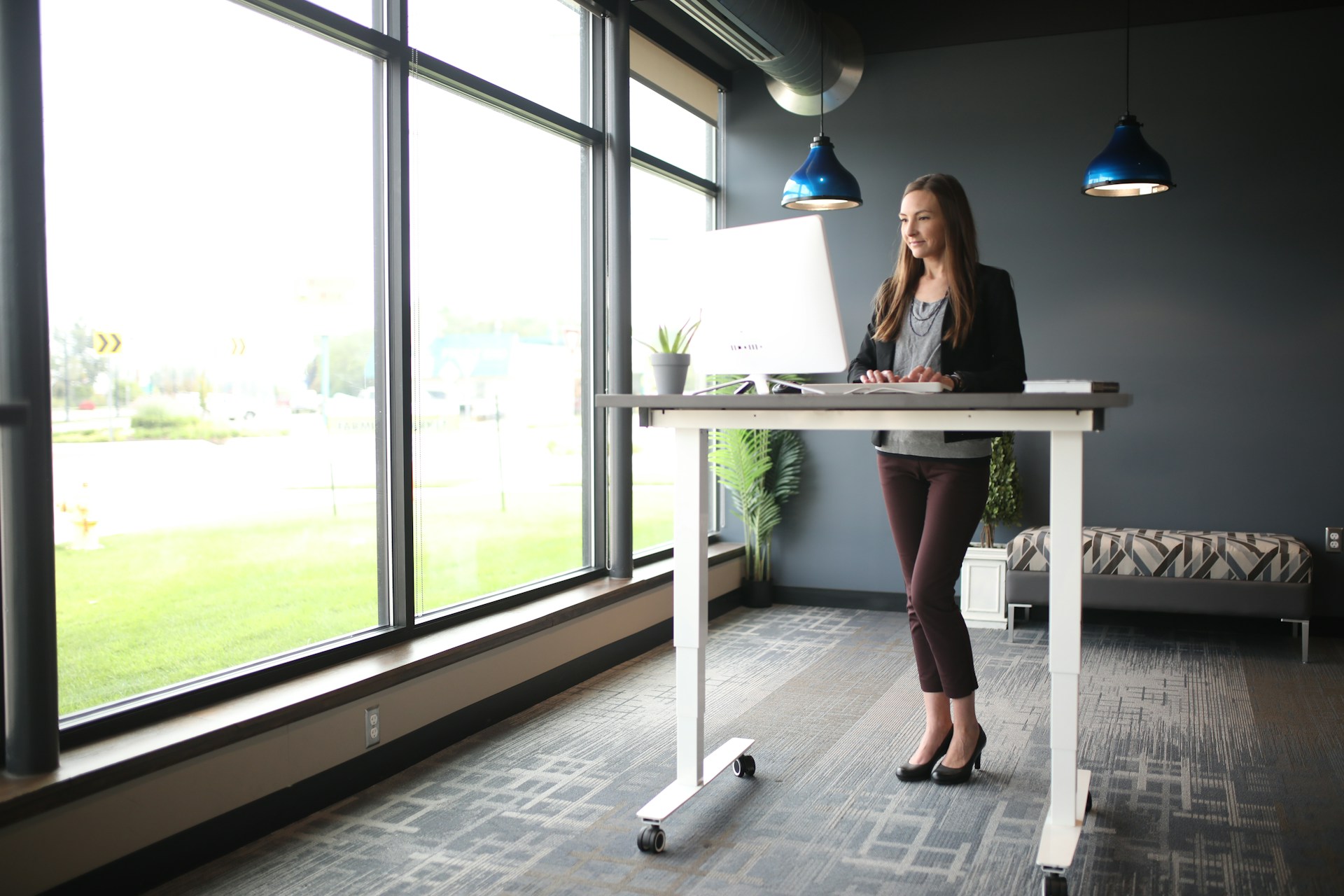
  • Variety: If you use a sit-stand desk, the goal is not to stand for eight hours (which fatigues the lower limbs), but to alternate positions approximately every two hours.

By breaking sedentary patterns, you restart the "blood pump" and reduce soft tissue inflammation. It is your first line of defense against chronic pain.


2. The Second Pillar: Postural Alignment and the 90° Rule

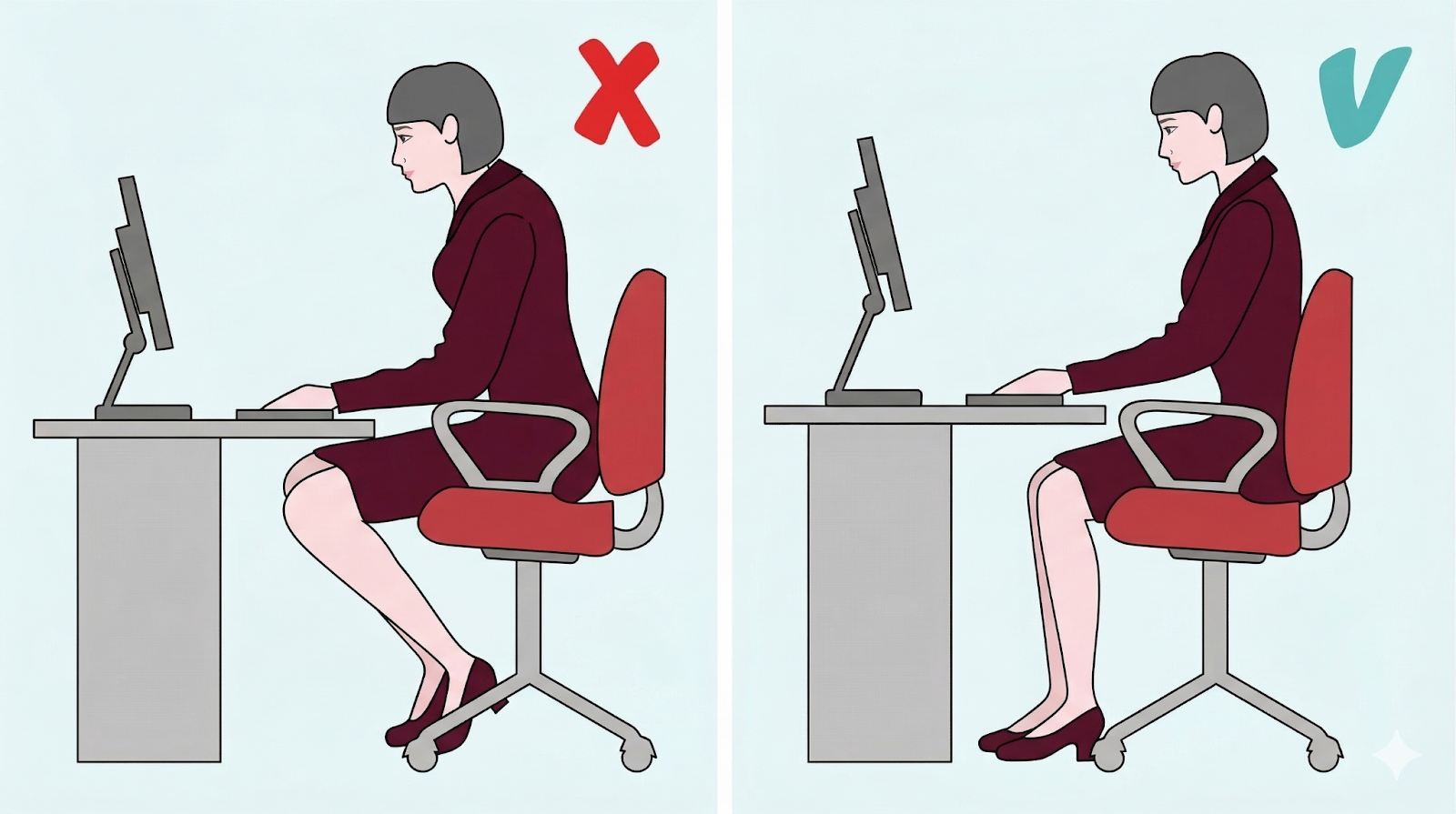
Poor sitting posture is often the starting point for chronic lower back pain. A chair should not be just a seat, but an active support tool.

The Geometry of Comfort: To minimize tension, it is crucial to respect the natural alignment of your joints:

  • The Right Angle (90°): Elbows should rest close to the body, forming a right angle toward the keyboard. Knees and hips should also follow this rule.
  • Foot Support: If your feet do not touch the floor firmly, the weight of your legs pulls on your lumbar vertebrae. Using a footrest can, on its own, resolve many back issues.
  • Lumbar Support: The natural curve of the lower back must be supported by the chair's backrest. Without this support, the spine collapses into a "C" shape, creating uneven pressure on the discs.
undefined


3. The Third Pillar: The Cervical Zone and the Visual Horizon

"Tech neck" is no longer reserved for smartphone users; it threatens any worker whose screen is poorly positioned. When you tilt your head forward by just 15 degrees, the actual weight supported by your neck doubles, jumping from about 12 lbs to nearly 27 lbs.

Protecting Your Neck:

  • Screen Height: The top of your monitor should be at eye level. This allows your gaze to descend naturally toward the center of the screen without your neck bending forward.
  • Distance: The screen should be about an arm's length away. Too close, and you strain your eyes; too far, and you unconsciously jut your chin forward to read better, creating tension at the base of the skull.


The Financial Impact: Why HR Must Care

Investing in ergonomics is a logical business decision. The cost of a high-quality ergonomic chair and a monitor stand is minimal compared to the costs of a prolonged absence.

  • The Cost of "Presenteeism": Beyond absenteeism (the employee who doesn't show up), there is presenteeism. This occurs when an employee is at their desk but their productivity is reduced by 20% to 50% because they are struggling with a dull ache or a tension migraine. An ergonomic environment maintains high levels of focus and engagement throughout the day.
  • Retention and Employer Branding: In a labor market where talent is scarce, attention to physical health is a powerful signal. A company that provides adapted equipment and encourages active breaks demonstrates an authentic culture of well-being, thereby promoting employee retention.


Conclusion

Ergonomics should no longer be seen as an option, but as a wise investment in prevention. By educating your teams on the importance of movement, proper screen adjustment, and posture, you are acting on your company’s most precious lever: human capital.